
Echo Health (QuicRemit): Avoid the 3% Fee
By George Ruan • June 26, 2026
If a payer pays you through ECHO Health, you're probably losing 2–3% of every payment to a fee you never agreed to. Bomi gets you off virtual cards and onto no-fee direct deposit so your full payment lands in your account.
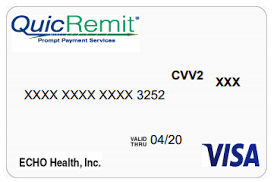
You open what looks like an insurance payment from ECHO Health and find a QuicRemit virtual card — a single-use card number you're told to “redeem” by running it in your merchant portal. Run it, and a credit-card processing fee (typically 2–3%) comes straight out of your payment.
Sections
What ECHO Health is
ECHO Health (its virtual-card product is branded QuicRemit) is a payments vendor that health plans and third-party administrators hire to deliver claim payments and remittances. Many payers route their provider payments through it. The virtual card carries a fee that's deducted from your payment when you run it — which is how it quietly costs practices 2–3%.
You have a right to no-fee EFT — here's the law
Here's what most practices don't realize: under the federal electronic-payment standard for health care (adopted through Section 1104 of the Affordable Care Act and the rules at 45 CFR 162.1601–162.1602), every health plan must, on your request, pay your claims through the standard ACH bank transfer — the ordinary, no-fee electronic deposit. CMS has been explicit: a health plan, or a payment vendor like ECHO acting for it, cannot require you to accept virtual credit card payments, and if you ask to be paid by the standard EFT instead, the plan must comply.
CMS guidance also says no fee should attach to that standard EFT itself. The 2–3% you see deducted is a charge for an optional value-added service (the virtual card) that you can decline. It is not a toll you have to pay to get paid electronically.
One honest nuance: this is a right to a no-fee standard transfer on request, not a blanket ban on every fee. A 2–3% charge for an optional service you actually chose is allowed; what a plan or vendor cannot do is force the fee on you as the price of electronic payment. If one won't honor a clean standard-EFT request, the recourse is a complaint to CMS through its Administrative Simplification (ASETT) system.
How to switch: opt out, then enroll payer by payer
There's no single national switch — you do it one payer at a time. For each payer paying you through ECHO Health:
Opt out of the QuicRemit virtual card. Contact ECHO Health (their provider line is 888-834-3511) and decline the virtual card; the payment then rolls over to a check. Don't run the card in the meantime — running it is what triggers the fee.
Enroll in no-fee standard ACH EFT (with ERA). Submit ECHO Health's EFT/ERA enrollment for that payer, with your practice TIN/EIN, NPI, and bank account, and choose to receive your remittances (835/ERA) electronically.
If a plan resists, escalate. A plan or its vendor cannot condition electronic payment on a fee. If they won't honor a clean standard-EFT request, file a CMS Administrative Simplification (ASETT) complaint naming the health plan.
It's tedious, payer-specific paperwork, which is exactly why most practices never do it and keep losing the percentage.
How Bomi helps
Bomi runs this for you. We opt your practice out of ECHO Health / QuicRemit virtual cards, enroll you in the no-fee standard ACH EFT for each payer that uses ECHO, and set up your electronic remittances so payments post cleanly. You stop losing 2–3%, and you don't touch the paperwork.
This article is general information, not legal advice. The protections described come from federal CMS guidance and your right to request the standard EFT transaction; enforcement runs through the CMS complaint process, and specifics can change. Confirm your options with the payer and CMS before relying on them.
Want us to get the virtual-card fees off your payments? Reach us here https://www.billwithbomi.com/#contact.
Related
Want Bomi to handle insurance billing?
Bomi helps therapy practices with benefit checks, claims, denials, balances, CAQH, attestations, and revenue management.
Talk to Bomi about billing